
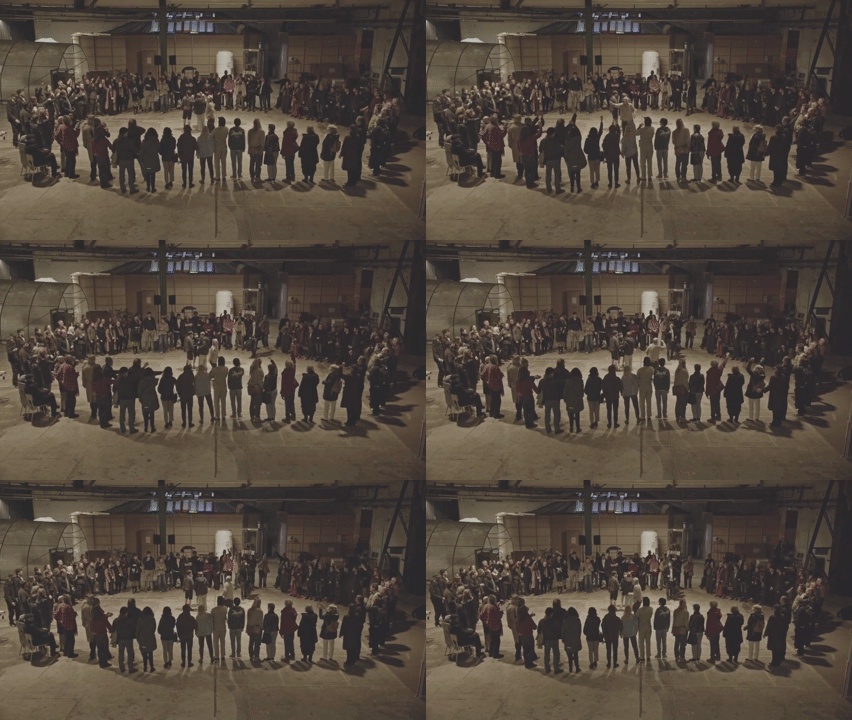
Swarm Pieces are collective compositions that operate according to a mildly guided democracy. There is no hierarchical conductor and no individual virtuosity that determines the course of events. The piece emerges from the group itself: from attention, timing, and mutual attunement.
In Swarm Pieces #1, the musicians are distributed around the audience. They play small sound objects—matchboxes—that generate a finely woven, fragile sonic field. The listener is situated in the middle of this field. Sound is not presented as linear music, but as a spatial phenomenon in constant flux.
An essential aspect of the work is sound localization. The piece activates a sensory instinct deeply embedded in the human brain: the ability to perceive direction, distance, and movement of sound. This ability was once crucial for survival, but in today’s visually dominated culture has largely receded into the background. Swarm Pieces #1 brings this forgotten sense back to the foreground.
The dramaturgical climax is the wave: a circulating sound motion that sweeps through the space. Inspired by the stadium wave, but now auditory and spatial, a movement emerges in which sound itself rotates around the audience. This wave cannot be forced; it arises only when a sufficient number of participants synchronize their attention.
Virtuosity is irrelevant here. What matters is concentration, listening, and the willingness to become part of a collective experience. The scale of the group is decisive: the more participants, the stronger the emergent effect and the more tangible the sonic field.
Although the work does not illustrate a scientific theory, it shows a structural affinity with quantum mechanics. As in quantum systems, the behavior of the whole cannot be reduced to its individual components. Form and meaning arise from simultaneity, interaction, and probability. The piece does not exist as a fixed object, but as a field of possibilities that is continually re-actualized in the encounter between participants, space, and attention.